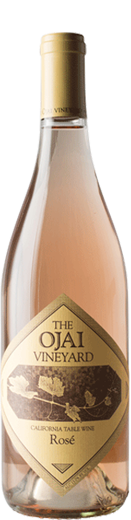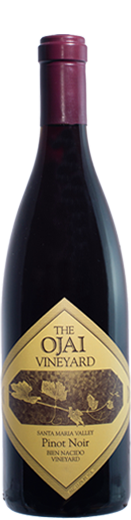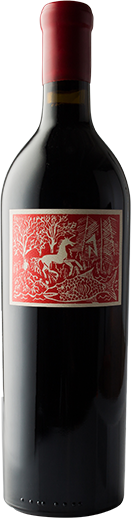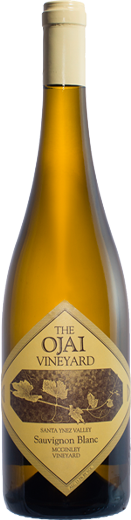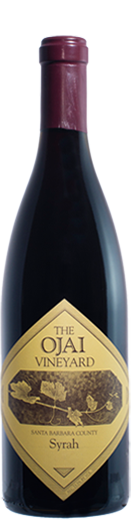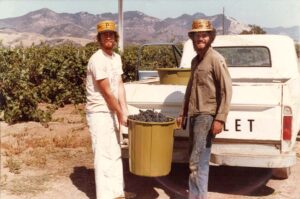
As a teenager, Adam spent a lot of time on his grandfather’s property in Ojai turning over rocks looking for lizards and tarantulas. His uncle Robert, an artist, read up on viticulture and decided to plant Barbera on the property, however birds and gophers made the growing difficult, and Adam lovingly made the only harvestable vintage into a very tart, lean wine.That, with more successful batches of apricot, peach and strawberry wine led him on a path to UC Davis, where he studied wine and viticulture in the 1970s. After graduating in 1976 he went back to the family property and grew sweet corn and melons, selling them at a roadside stand where Encino Drive meets Highway 33 in Ojai.
After two years of the hardest work he had ever done (don’t fool yourself, commercially growing vegetables is difficult!) he re-directed himself and sought employment in his field of study, winemaking. With a degree from UC Davis, he found work at Zaca Mesa Winery in Santa Barbara County. Jim Clendenen had started at Zaca the year before and they shared a passion for cellar work and were both generally ecstatic about wine and winemaking. Seeking travel and inspiration, they found harvest jobs in Burgundy through the late and extremely influential Becky Wasserman.
It was in Burgundy that Adam truly learned what it takes to make great wine. He saw firsthand that some of the best wines in the world were being made in incredibly modest family-owned wineries. He saw that it has nothing to do with fancy cellar machinery or advanced technology, and everything to do with good farming and intention and thoughtfulness in the cellar. He and Jim saved all of their harvest earnings and spent it all on one 5-star lunch in France that lasted one delightful afternoon.. Upon their return, they started Au Bon Climat Winery in 1982. One year later, Adam started his own winery called The Ojai Vineyard, where the first vintages were bottled from the vines he had planted before leaving for Burgundy — on the same farm he used to make fruit wines from as a kid, his grandfather’s property in Ojai. For nine years Adam ran ABC and The Ojai Vineyard simultaneously — but eventually Jim and Adam realized they had to follow separate paths. Jim bought the business in 1991 and went on to further glories — Adam focused all of his attention on The Ojai Vineyard.
Back then a lot of vines were grown without much care in what was called a California sprawl. It took years to get growers to move towards progressive practices like drip irrigation and vertical trellising to improve wine grape quality. Adam was a pioneer in this respect, convincing farmers to prioritize quality over quantity. He worked relentlessly in the cellar to fine-tune the winemaking process to make it as natural as possible, using only tiny quantities of sulfites and avoiding fining and filtering, with an aim to further improve quality.
“In business, it’s really easy to produce something universally appealing..but if you’re really into craft, you don’t do that, you have to fight that and make wines of subtlety, finesse and distinction..”
The question of climate is also a cornerstone — his years of experience showed him how the cooler climate sites were always better balanced and more expressive terroirs. He grew determined to focus on those sites completely, and in 2020 he purchased Fe Ciega Vineyard, a cool Sta Rita Hills vineyard that he had made wine from since 2003.
Coming up on his 44th vintage, Adam is still the winemaker and the sole proprietor of The Ojai Vineyard. He has remained whole-heartedly dedicated to his craft, fueled by a genuine love for what he does.
In the least pretentious way possible, Adam is trying to make some of the finest wines in the world.